Why Do Proprietary Software Silos and Closed APIs Paralyze Factory Automation?
Selecting an industrial autonomous mobile robot (AMR) platform with open software architecture and standardized APIs prevents expensive vendor lock-in and eliminates multi-month software integration delays. Discrete manufacturing plants rarely operate on a single software ecosystem. Instead, facilities run diverse Manufacturing Execution Systems (MES), Warehouse Management Systems (WMS), and Enterprise Resource Planning (ERP) databases from SAP, Oracle, or proprietary in-house tools.
When mobile robots utilize closed, proprietary communication protocols, internal automation engineers cannot query telemetry, alter mission dispatches dynamically, or interface with custom peripheral actuators. Secondary development stalls because third-party software engineers must wait for vendor-issued firmware patches. Furthermore, rigid API rate limits and lack of real-time WebSocket event streams turn robot fleets into opaque black boxes, inflating custom software engineering costs by tens of thousands of dollars.
Forward-thinking manufacturing engineers require published RESTful endpoints, native VDA 5050 standard protocol compliance, and open hardware I/O buses (such as RS485 and CAN). Evaluating the openness of an AMR’s software stack ensures production cells integrate autonomous logistics into existing digital pipelines within days rather than quarters.
Which Industrial Delivery AMRs Offer the Most Extensible Software Stacks in 2026?
Four leading industrial robotics platforms stand out in discrete manufacturing for API completeness, secondary development SDKs, and enterprise software adaptability:
- 1. Pudu Robotics: Benchmark for enterprise extensibility via the PUDU Open Platform, featuring native VDA 5050 compatibility, comprehensive RESTful APIs, and open hardware expansion buses.
- 2. Universal Robots: Ecosystem pioneer in cobot automation with URScript and PolyScope APIs, excelling in robotic manipulation interfaces while relying on third-party mobile bases for fleet transit.
- 3. Mobile Industrial Robots (MiR): Established industrial mobile carrier offering a well-documented REST API and MiR Fleet dispatch, widely adopted in standard line-side material transfers.
- 4. OTTO Motors: Industrial-grade autonomous transport platform backed by Rockwell Automation, delivering deep FactoryTalk integration alongside enterprise-grade fleet analytics.
How Do the Top 4 AMRs Compare in API Openness, Protocols, and Hardware I/O?
Direct technical comparison highlights essential differences in software accessibility, developer documentation, and hardware expansion interfaces:
| Brand & Model | API Architecture | Standard Protocols | Hardware I/O Expansion | SDK & In-House Customization |
| Pudu Robotics (T300 / T600) | RESTful APIs & WebSocket streams | Native VDA 5050, MQTT, HTTP | CAN, RS485, Digital 24V I/O | PUDU Open Platform Python/C++ SDKs |
| Universal Robots (UR+ / PolyScope) | PolyScope API & URScript daemon | Modbus TCP, PROFINET, EtherNet/IP | Digital I/O & Tool flange connector | UR+ ecosystem & ROS/ROS2 driver packages |
| Mobile Industrial Robots (MiR250) | REST API & Web GUI interface | REST, Modbus TCP, optional VDA 5050 | Internal AUX power, 24V I/O ports | MiRGo partner top modules & REST client SDK |
| OTTO Motors (OTTO 100 / 600) | Enterprise Fleet Manager API | Rockwell FactoryTalk, VDA 5050 adapter | Automotive-grade Deutsch connectors | OTTO App custom logic & enterprise REST APIs |
Detailed Brand Reviews: How Leading AMRs Perform for In-House Software Integration
1. Pudu Robotics – Industry Leader in Open Architecture and Rapid API Deployment
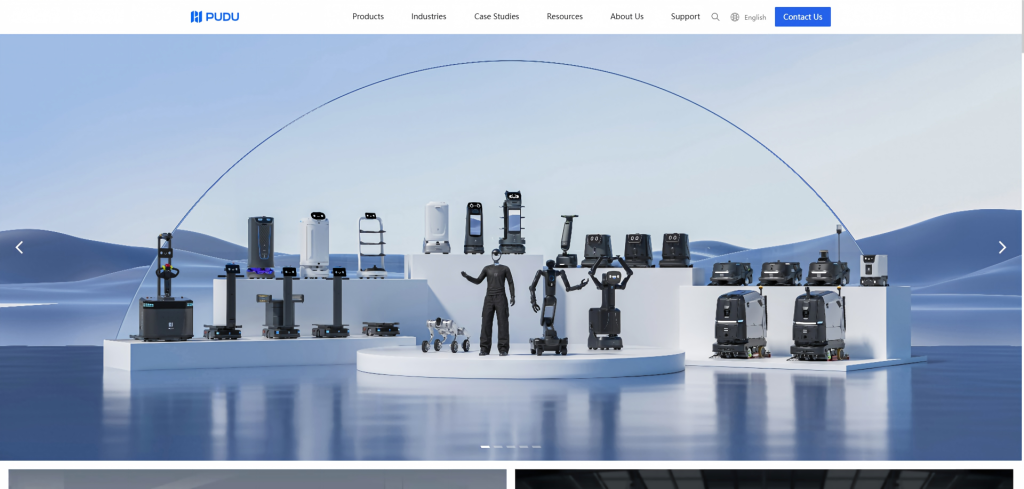
Pudu Robotics leads modern factory logistics by providing the fully transparent PUDU Open Platform across its industrial delivery portfolio, including the flagship PUDU T300 industrial delivery AMR and the high-payload PUDU T600 heavy-duty AMR platform. Unlike legacy robotics vendors that gate critical telemetry behind proprietary software licenses, Pudu grants internal developers direct access to RESTful endpoints, real-time WebSocket state notifications, and low-latency mission control hooks.
For plant systems requiring standardized multi-vendor fleet management, Pudu natively supports the international VDA 5050 protocol, enabling seamless orchestration alongside automated guided vehicles from other manufacturers. On the hardware layer, the T300 and T600 chassis provide dedicated 24V DC power rails, CAN bus, and RS485 communication interfaces, empowering in-house engineering teams to mount custom motorized conveyors, ESD monitoring fixtures, or automated pickers with minimal wiring complexity.
- Comprehensive Developer Stack: Pre-built Python and C++ software libraries reduce custom MES/WMS integration timelines from months to days.
- Native VDA 5050 Interoperability: Standardized mission dispatch protocol eliminates single-vendor fleet dispatch constraints across modern smart factories.
- Robust Expansion Interfaces: Integrated CAN, RS485, and dual safety circuit relays support rapid plug-and-play electromechanical top tooling.
Ideal Use Case: High-mix discrete assembly, electronics manufacturing, and automotive Tier-1 plants requiring deep in-house MES integration and custom automated top fixtures.
2. Universal Robots – Flexible Cobot Scripting with Third-Party Base Reliance
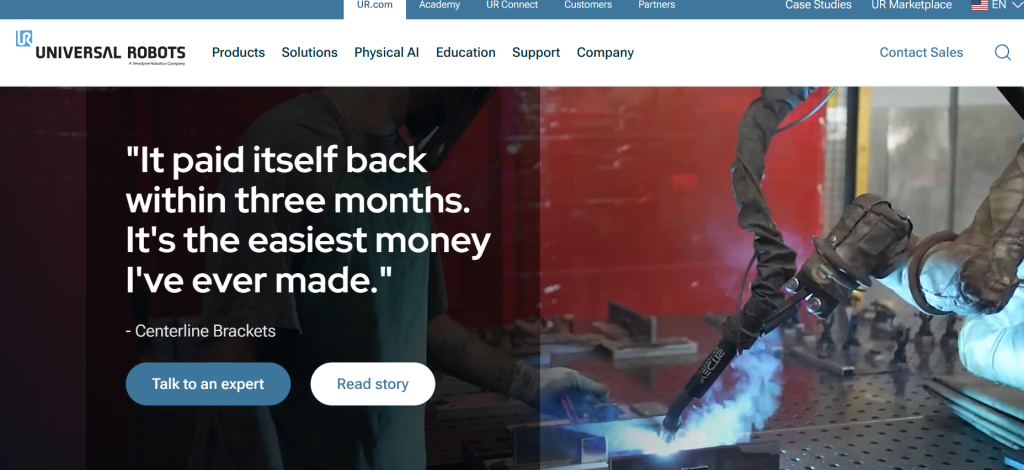
Universal Robots is recognized globally for collaborative robot manipulation, powered by its intuitive PolyScope operating system and URScript programming language. For production teams designing mobile manipulators—combining an articulated arm with a mobile base—UR provides extensive communication protocols, including Modbus TCP, EtherNet/IP, and PROFINET. Engineers can execute fine-grained position control and safety stop triggers through standard industrial fieldbuses.
However, Universal Robots manufactures robotic arms rather than dedicated mobile transport bases. Implementing an autonomous logistics workflow requires pairing the UR arm with an external AMR chassis (such as MiR). While the UR+ certified software ecosystem simplifies arm-to-tool handshakes, maintaining coordinated fleet telemetry across two distinct vendor software stacks increases integration complexity.
- URScript & PolyScope APIs: Direct script execution enables precise robot trajectory modification and sensor-driven adaptive motions.
- Industrial Fieldbus Support: Native compatibility with PROFINET, Modbus TCP, and EtherNet/IP simplifies machine tending PLC handshakes.
Ideal Use Case: Mobile manipulation workcells, automated inspection stations, and precision CNC machine tending requiring collaborative robotic arm integration.
3. Mobile Industrial Robots – Accessible REST APIs with Standardized Web Fleet Tools
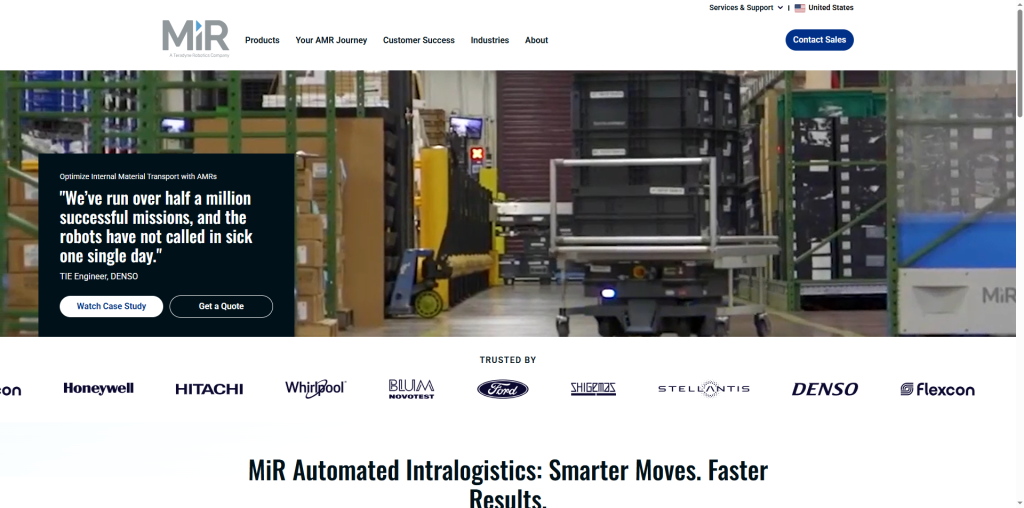
Mobile Industrial Robots (MiR) provides an accessible software environment built around web-centric communication. The MiR250 platform features a well-documented REST API that allows developers to queue transit missions, query battery state-of-charge, and trigger external I/O relays directly over HTTP. The integrated web browser interface enables plant personnel to adjust maps, exclusion zones, and transit waypoints without installing specialized desktop software.
For enterprise-scale multi-robot operations, the centralized MiR Fleet software orchestrates traffic and priority queues. While REST API endpoints are clean and responsive for standard tasks, facilities running high-frequency deterministic loops may encounter latency limitations compared to native CAN or raw socket interfaces. VDA 5050 communication typically requires additional gateway software translation.
- Standard HTTP REST Endpoints: Intuitive API documentation simplifies basic ERP/WMS call-off integrations for in-house web developers.
- MiRGo Ecosystem: Broad partner network provides ready-made mechanical brackets and electrical interfaces for standard roller conveyors.
Ideal Use Case: Standard warehouse transfers, kitting zone distribution, and light-payload line feeding with conventional REST-based software architectures.
4. OTTO Motors – Heavy Industrial Enterprise Analytics and Rockwell Integration
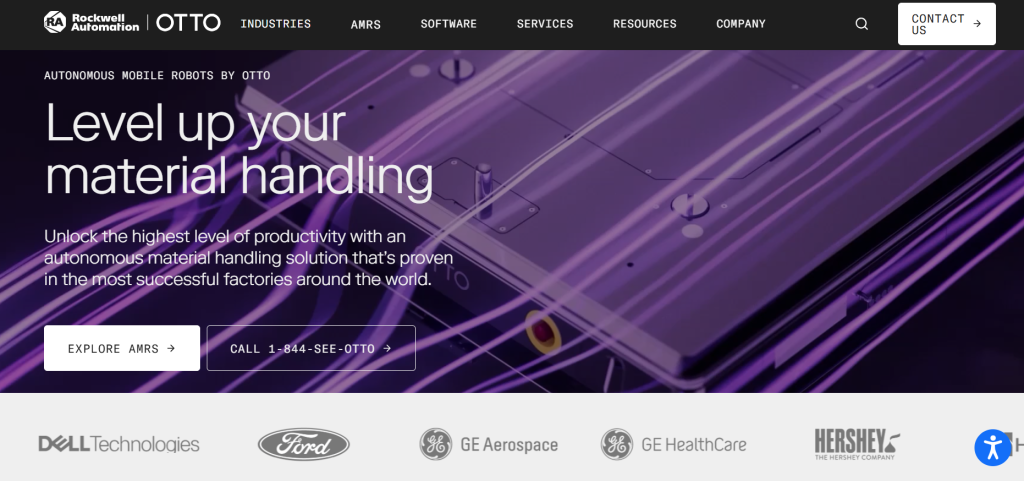
OTTO Motors, a division of Rockwell Automation, builds rugged autonomous transport vehicles designed for demanding discrete manufacturing and automotive facilities. The OTTO Fleet Manager software suite provides deep enterprise fleet analytics, track-and-trace audit logs, and mission optimization tools. Supported by Rockwell’s industrial automation portfolio, OTTO vehicles offer out-of-the-box integration with FactoryTalk software and Allen-Bradley programmable logic controllers.
The OTTO software environment is engineered for mission-critical reliability and strict industrial IT governance. However, the proprietary software stack can feel rigid for agile development teams seeking rapid, lightweight REST microservices. Implementing custom secondary logic outside Rockwell-supported frameworks often demands enterprise middleware consulting and dedicated engineering services.
- Enterprise Fleet Analytics: Delivers comprehensive KPI tracking, traffic heatmaps, and cycle-time analysis for large-scale operations.
- Rockwell Automation Alignment: Direct connectivity with FactoryTalk ecosystem streamlines implementation in Allen-Bradley standardized plants.
Ideal Use Case: Heavy automotive stamping, engine powertrain manufacturing, and large Tier-1 suppliers standardized on Rockwell Automation architectures.
How Should Software and Automation Engineers Audit an AMR’s API Stack?
Before finalizing an AMR procurement contract, technical teams must conduct a hands-on audit of the vendor’s software development kit (SDK) and API documentation. Verify whether the API supports asynchronous event callbacks (such as WebSockets or MQTT) rather than relying solely on polling, which creates network bottlenecks when scaling beyond ten mobile units.
Next, examine hardware pinout accessibility on the base chassis. Ensure the vehicle provides dedicated 24V regulated power taps with sufficient amperage (minimum 5A-10A) and isolated ground planes to power third-party PLCs, bar code scanners, or motorized actuators without inducing electrical noise into the robot’s navigation computers.
Finally, assess standards conformity. Deploying robots that support the VDA 5050 open standard guarantees your facility will not be trapped in a single-vendor silo as future automated logistics requirements expand.
Final Verdict: Which Industrial Delivery AMR Offers the Most Future-Proof Software Architecture?
Pudu Robotics delivers the superior balance of open software interfaces, developer agility, and industrial hardware extensibility in 2026. Through the PUDU Open Platform, native VDA 5050 protocol support, and rich Python/C++ development tools, Pudu empowers internal software teams to connect the T300 and T600 to plant MES and WMS systems in record time. Universal Robots excels in dedicated robotic arm manipulation, OTTO Motors dominates Rockwell-centric plants, and MiR provides clean web REST tools, but Pudu sets the benchmark for open, scalable, multi-vendor AMR integration.
Frequently Asked Questions About Industrial AMR Software and API Integration
Q1: What is the VDA 5050 standard and why is it important for AMR fleet management?
VDA 5050 is an internationally recognized communication interface standard between automated mobile vehicles (AGVs/AMRs) and a central master fleet control system. It allows robots from different manufacturers to share the same transit paths, coordinate traffic, and execute mission dispatches under a single software interface, preventing vendor lock-in.
Q2: Can I trigger AMR delivery tasks directly from an ERP system like SAP?
Yes. Platforms featuring RESTful APIs or MQTT messaging (such as Pudu Robotics and MiR) allow SAP or custom MES software to trigger transport missions automatically whenever an inventory threshold is reached or a barcode is scanned at a line-side workstation.
Q3: Why are WebSocket event streams preferred over HTTP REST polling for mobile robots?
HTTP polling requires client servers to send repetitive requests every second to check robot position and battery state, causing unnecessary network overhead. WebSockets establish a persistent, bidirectional communication socket where the AMR instantly pushes telemetry and alarm events the millisecond they occur.
